









Innokenty Annensky

The Anguish of a Mirage
Read Next
Literary Commentary
"The Anguish of a Mirage" is one of Innokenty Annensky's posthumously published lyrics in his тоска (anguish) cycle. Seven quatrains stage a winter sleigh journey toward an absent woman; the first stanza returns verbatim as the seventh, sealing the speaker inside a circle that the journey could not break. The envelope is the poem's argument about anguish.
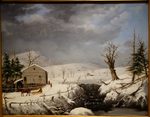
Inside that frame, the speaker travels through snow at dusk, hears bells, and watches another sleigh approach. The two will pass on the white road; for a moment the bells of both teams will sound together, then separate. The woman the speaker yearns toward is at once distant and felt to be near (the mirage of the title), and the meeting that the snowscape seems to promise will not occur.
Annensky's method, as always, is to lodge an inner state inside concrete things: a faded sunset, sleigh-bells, the trackless white. Yevgeny Bonver's English translation preserves the seven-quatrain shape and the ABAB rhyme, sometimes through approximate rhyme ("reddish/maddish," "count/around"), and lets the interior music of the Russian come through as a quieter, plainer English.
Key themes
- Anguish (тоска) as a permanent inner climate, not an episode
- Absence and the unattainability of the beloved
- The fairy tale (сказка) that consoles and torments at the same time
- The doubled or divided self that knows one thing and feels another
Notable craft elements
- Envelope structure: stanza 1 returns as stanza 7, framing the journey as a closed circle
- Seven ABAB quatrains in a short, song-like Russian line; in Bonver's English, ABAB approximated through near-rhyme
- The bells (бубенцы) as the poem's recurring auditory image — they ring twice, once for each sleigh, and are heard together for an instant before separating
- The closing image of «безысходный круг» (a circle without exit) — a Russian word whose root means "no way out"
Reread prompt
When stanza one returns as stanza seven, has anything changed for the speaker, and if not, what has the journey through the middle five stanzas been for?
See something wrong on this page? Let us know.