







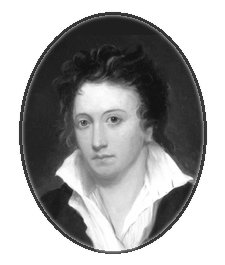
Percy Bysshe Shelley

To a Skylark
Read Next
Literary Commentary
Percy Bysshe Shelley composed "To a Skylark" near Livorno, Italy, in the summer of 1820, after hearing a skylark's song during an evening walk with his wife Mary. The poem addresses a bird that is heard but never seen, transforming its invisible music into a reckoning with the distance between effortless natural joy and the burdened consciousness of human beings.
The poem unfolds in three movements. Its opening six stanzas track the skylark's ascent into the evening sky, where it dissolves into sound alone. The next six stanzas attempt to capture the bird through analogy: a poet singing unheard, a maiden in a tower, a glow-worm scattering light unseen, a rose whose fragrance escapes its petals. Each comparison grasps at something hidden yet radiant, and each falls short. The skylark's song exceeds every earthly parallel because the bird, in Shelley's framing, knows nothing of the sorrow that shadows all human pleasure.
The final nine stanzas turn philosophical. Shelley observes that human happiness is always entangled with memory and longing: "We look before and after, / And pine for what is not." The poem's most quoted line, "Our sweetest songs are those that tell of saddest thought," crystallizes the paradox at its center. When Shelley closes by asking the skylark to teach him "half the gladness," the word "half" matters. Full skylark joy would require an innocence incompatible with human art. The poem does not resolve this tension, ending where every honest reckoning with inspiration must end: in the gap between what we hear and what we can make.
Key themes
- The skylark as an emblem of ideal, unburdened joy
- The inadequacy of human language and analogy
- Art born from the inseparability of pleasure and pain
- Transcendence and the limits of mortal consciousness
- Nature as a model for spontaneous, unpremeditated creation
Notable craft elements
- Stanza form of four trochaic trimeter lines capped by an iambic hexameter alexandrine, creating a rhythmic pattern of short darting lines followed by a sustained release
- A cascade of similes, each introduced by "Like," that descends from the cosmic to the natural while emphasizing hiddenness and unseen radiance
- Chiasmus in stanza 2 ("singing still dost soar, and soaring ever singest") that fuses flight and song into a single continuous action
- Strategic shift from descriptive to interrogative mode in the final third, turning the poem from portrait to philosophical inquiry
Reread prompt
When Shelley asks for only "half the gladness" of the skylark, what does this concession reveal about his understanding of human creativity?
See something wrong on this page? Let us know.