








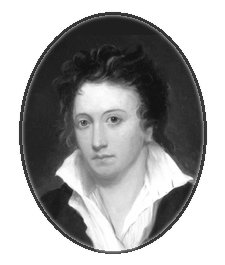
Percy Bysshe Shelley

Mont Blanc
Read Next
Literary Commentary
Percy Bysshe Shelley composed Mont Blanc during the summer of 1816, the same weeks at Lake Geneva that produced Hymn to Intellectual Beauty and the early chapters of Mary Shelley's Frankenstein. Where the Hymn addresses an invisible, elusive power, Mont Blanc fixes on something brutally visible: a mountain that dwarfs every human claim to significance. The poem opens with a metaphor that equates the universe of things with a river flowing through the mind, then turns to the Ravine of Arve and the glacier-scarred peak above it, testing whether the mind merely receives the world or actively creates its meaning.
The five irregular sections trace a tightening argument. In the opening, thought and nature merge in a single current. By the second section, Shelley stands in the ravine and watches his own consciousness respond to the scene, observing how perception shuttles between the landscape and the mind's own fantasies. The third section raises the stakes: the mountain appears above the clouds, surrounded by desolation, and Shelley asks whether some unknown omnipotence has lifted the veil between life and death. His answer is not Coleridge's confident hymn to a creator God but a refusal to settle the question.
Section IV catalogs nature's destructive and creative power with relentless precision, tracing the glaciers that demolish forests, overthrow the limits of the living world, and drive human communities into flight. Yet the passage is not despair. Power, Shelley writes, dwells apart in its tranquillity, remote and inaccessible, a force that does not care whether it builds or ruins. The final section gathers these strands into a single closing question: if silence and solitude were vacancy to the human mind, what would the mountain be? The question is genuine, not rhetorical. Shelley refuses to answer it, leaving the reader suspended between two possibilities: that meaning is a gift of the mind or that the mountain's power exists independent of anyone watching.
Among the major Romantic meditations on landscape, Mont Blanc stands apart for its intellectual honesty. Wordsworth's Tintern Abbey resolves into faith; Coleridge's Hymn Before Sunrise resolves into praise. Shelley's poem resolves into a question that remains open two centuries later, and that resistance to closure is what keeps it alive.
Key themes
- The sublime: nature's indifferent, overwhelming power and the human response to it
- Epistemology: the relationship between the perceiving mind and the external world
- Skepticism and the limits of human knowledge about ultimate causes
- The poet as interpreter who mediates between nature and humanity
- Destruction and creation as inseparable aspects of natural force
Notable craft elements
- Irregular blank verse with variable rhyme, mirroring the untamed landscape Shelley describes
- Extended water metaphor: thought as river, the Arve as conduit between mind and mountain
- Long, enjambed sentences that enact the breathless accumulation of perception
- Strategic rhetorical questions that shift the poem from description to philosophical inquiry
Reread prompt
On rereading, pay attention to the final two lines: does Shelley's question imply that silence and solitude are vacancy, or that the human mind prevents them from being so?
See something wrong on this page? Let us know.