






← Back to “Ode to Psyche” by John Keats

“Ode to Psyche” by John Keats — Literary Analysis
Overview
John Keats's 'Ode to Psyche' (1819) is the first of his great spring odes and the one he told his brother he had taken 'moderate pains' over. Addressed to a goddess canonized too late for any classical cult, the 67-line poem ends by pledging to build her a temple inside the speaker's own mind — a manifesto of Romantic interiority that the other 1819 odes would develop in different directions.
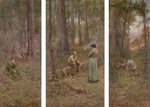
The opening stanza stages an accidental encounter. A speaker wandering 'thoughtlessly' in a forest comes upon two sleeping figures — 'The winged boy I knew; / But who wast thou, O happy, happy dove? / His Psyche true!' The setting is almost still-life: 'whisp'ring roof / Of leaves and trembled blossoms,' a 'brooklet, scarce espied,' flowers 'Blue, silver-white, and budded Tyrian.' Keats's mythological source is Apuleius's 'The Golden Ass' (second century CE), likely in William Adlington's 1566 translation; Psyche was never part of living Greek religion. That late arrival is the condition the poem works from. She is, in Keats's phrase, 'latest born and loveliest vision far / Of all Olympus' faded hierarchy.'
The central two stanzas turn on a single rhetorical gesture. Stanza 2 enumerates what Psyche lacks: 'No voice, no lute, no pipe, no incense sweet / From chain-swung censer teeming; / No shrine, no grove, no oracle, no heat / Of pale-mouth'd prophet dreaming.' Stanza 3 returns the same inventory as affirmation: 'Thy voice, thy lute, thy pipe, thy incense sweet... Thy shrine, thy grove, thy oracle, thy heat / Of pale-mouth'd prophet dreaming.' The devotional catalogue does not change its furniture; it only changes its grammar. Absence becomes endowment without an added word.
The closing stanza makes the vow literal: 'Yes, I will be thy priest, and build a fane / In some untrodden region of my mind.' The sanctuary is anatomical ('wild-ridged mountains steep by steep,' 'zephyrs, streams, and birds, and bees'), architectural ('the wreath'd trellis of a working brain'), and, finally, erotic. The last image — 'A bright torch, and a casement ope at night, / To let the warm Love in' — refuses closure. The temple is lit and receptive; the union of Cupid and Psyche is still coming. Of all the 1819 odes, this one ends with the window open.
Key Themes
- The sanctity of inward worship
- Love as union of body and soul
- Mythmaking without inherited tradition
- The mind as sacred landscape
- Imagination as vocation
Notable Craft Elements
- Irregular ode of four unequal stanzas (23, 12, 14, 18 lines), predominantly iambic pentameter broken by shorter lines that punctuate the verse with moments of arrested attention.
- Mirror construction in stanzas 2 and 3: the negative catalogue ('No voice, no lute...') returns as affirmation ('Thy voice, thy lute...') with the same nouns in the same order.
- Synaesthetic sensuality — 'whisp'ring roof,' 'fragrant-eyed' flowers, 'soft-conched ear' — binds sight, sound, and touch in the Shakespearean manner Keats was steeped in through 1818-19.
- An open ending: the final couplets tighten into rhymed pairs, but the last image leaves a casement open to 'warm Love,' refusing the stoppage the later odes prefer.
Reread Prompt
Read stanza 2 and stanza 3 side by side. The vocabulary is nearly identical, but stanza 2 is a list of what Psyche has never received while stanza 3 is a list of what the speaker will provide. What changes when 'no voice, no lute' becomes 'thy voice, thy lute' — and what, if anything, stays the same?
Historical Context
Keats composed 'Ode to Psyche' at Wentworth Place in Hampstead during spring 1819, where he was lodging with his friend Charles Armitage Brown. He had passed the Society of Apothecaries licensing examination in July 1816, worked on as a dresser at Guy's Hospital until March 1817, and then turned to poetry full-time. By the spring of 1819 he had published 'Endymion' (1818), absorbed the hostile Blackwood's and Quarterly reviews, and entered what later critics would call his 'great year.' The ode opens that year.
Keats copied the poem into an ongoing journal-letter to his brother George and sister-in-law Georgiana in America, dated 14 February–3 May 1819. The prefatory note to George is the most-quoted single comment Keats ever made about his own compositional practice: 'The following poem, the last I have written, is the first and only one with which I have taken even moderate pains; I have, for the most part, dashed off my lines in a hurry; this one I have done leisurely; I think it reads the more richly for it, and it will I hope encourage me to write other things in even a more peaceable and healthy spirit.' The poem was published the following summer in 'Lamia, Isabella, The Eve of St Agnes, and Other Poems' (July 1820), the last book Keats saw through the press before his death in Rome in February 1821.
The mythological source is Apuleius's 'The Golden Ass' (second century CE), the principal ancient account of Cupid and Psyche and the one to which Keats was probably introduced through the Elizabethan translation by William Adlington (1566). The myth is late — Apuleius was writing at the twilight of classical religion — and Psyche was never a figure of established worship. Keats had also read Mary Tighe's Spenserian romance 'Psyche' (1805) as a teenager, but by 1819 he was finding his own way into the story. The poem's governing insight is the late date: Psyche belongs to a period 'too, too late / For the fond believing lyre.' Her cult is not lost; it never existed. That historical gap is what the speaker's vow answers.
Formal Analysis
The poem is 67 lines in four stanzas of unequal length (23, 12, 14, 18). It belongs to the irregular ode tradition that runs from Cowley through Collins and Gray — a stanza form designed to accommodate shifts of address, catalogue, and declaration rather than a fixed Pindaric or Horatian pattern. The predominant line is iambic pentameter, but Keats frequently drops to tetrameter, trimeter, or even dimeter: the clipped 'A brooklet, scarce espied,' 'Upon the midnight hours,' 'The winged boy I knew,' 'His Psyche true!' These short lines are not lapses. They work like fermatas, suspending the stanza at moments of attention or address.
Rhyme is irregular. Stanza 1 opens with a quasi-Shakespearean quatrain (ABAB) before wandering into a looser weave of couplets and isolated sounds. Stanzas 2 and 3 mirror each other in rhyme scheme as well as in argument — the parallelism is one of the ode's primary structural gestures. Walter Jackson Bate reads the form as Keats experimenting with what Bate calls an altered sonnet pattern, an expanded sonnet trying to hold dramatic scene, catalogue, and vow in one frame. The experiment is what makes 'Ode to Psyche' the laboratory of 1819: when Keats arrived at 'Nightingale' and 'Grecian Urn' soon after, he had standardized on a regular ten-line stanza. Psyche is the ode that had not yet settled on its shape.
The closing stanza enacts its own kind of settling. The last several lines tighten into rhymed couplets ('delight / night,' 'win / in') — a rare stretch of full couplet rhyming — as if the speaker were at last resolving the stanza into the measured architecture the earlier verses could not sustain. It is a small formal achievement, and it matters: the sanctuary inside the mind is the place where the verse finally settles.
Thematic Analysis
The hinge of the poem is a historical fact made thematic. Psyche was canonized too late for any Greek or Roman cult; the catalogue of her missing temple, altar, choir, and oracle in stanza 2 is not exaggeration but description. The speaker cannot restore a lost worship because there was none to lose. Devotion must therefore originate, not recover — and that changes the poem's emotional register. What might have been elegy for fading paganism becomes instead the exhilaration of invented vocation. Keats writes into a blank and takes the blankness as an opportunity.
The vow that begins 'In some untrodden region of my mind' moves worship out of any external sanctuary and into consciousness. Harold Bloom, in 'The Visionary Company,' calls the final stanza one of the finest epitomes of the myth-making faculty in English poetry; Helen Vendler, in 'The Odes of John Keats,' reads the ode as the opening move of the 1819 sequence — the moment Keats locates the odes' imaginative action inside the mind. The claim the speaker stakes is that attention and imagination can supply what historical religion never did. If no altar exists for Psyche, one will be built inwardly. The poem does not argue this position; it performs it. The mirror construction of stanzas 2 and 3 is the performance — nothing is added, only the grammar of ownership.
The third strand is erotic. Psyche, the Greek word for soul, is paired throughout with Cupid, the winged boy of the opening stanza. Body and soul, spirit and desire, lie together 'calm-breathing on the bedded grass,' their 'arms embraced, and their pinions too.' The final image keeps the pair in mind: a temple with 'a casement ope at night, / To let the warm Love in.' The interior is not ascetic. It is expectant. The union of Eros and Psyche does not conclude the poem; it is what the poem prepares to receive. Readers have often taken this open ending as the point where Keats most clearly distinguishes his ode from the closed cadences of 'Ode on a Grecian Urn' and the 'forlorn' dismissal that ends 'Ode to a Nightingale.'
Language & Imagery
Stanza 1 gives the dense sensory register Keats's contemporaries recognized as his signature. The forest glade is rendered through a saturation of small details: a 'whisp'ring roof / Of leaves and trembled blossoms,' a 'brooklet, scarce espied,' flowers 'hush'd, cool-rooted... fragrant-eyed, / Blue, silver-white, and budded Tyrian.' The adjectives are doubled and tripled; colour becomes tactile ('cool-rooted'), fragrance becomes visual ('fragrant-eyed'), and the Tyrian purple — a pigment from ancient Phoenicia, traditionally expensive — ties the botanical scene to a classical inheritance. The technique is synaesthetic in the Shakespearean manner Keats had been reading through 1818-19.
Stanza 2 inverts that density into a liturgy of absence. The anaphora — 'No voice, no lute, no pipe, no incense sweet... No shrine, no grove, no oracle, no heat' — is devotional in rhythm and subtractive in content. It behaves like a catalogue of religious furniture, but each noun is negated. The repetition builds a room by listing what is not in it.
Stanza 3 is the mirror. The same furniture returns as the speaker's pledge: 'Thy voice, thy lute, thy pipe, thy incense sweet... Thy shrine, thy grove, thy oracle, thy heat / Of pale-mouth'd prophet dreaming.' The substitution of possessive pronoun for negation is the central rhetorical gesture of the poem. Repetition moves from absence to endowment. The critic Kenneth Allott called this the most 'architectural' of Keats's odes, and the word fits: the stanzas are built out of each other like facing walls.
Stanza 4 builds the temple in earnest, and the building is anatomical. 'Wild-ridged mountains steep by steep' suggest cerebral convolutions; 'zephyrs, streams, and birds, and bees' move through that terrain like the circulations of a living body; 'the wreath'd trellis of a working brain' names the organ directly. Critics including Donald Goellnicht ('The Poet-Physician: Keats and Medical Science,' 1984) and Hermione de Almeida ('Romantic Medicine and John Keats,' 1991) have tracked this vocabulary against Keats's five years of medical training. The anatomical reading is one layer among several, not the definitive key — the stanza is also a garden and a shrine — but the overlap is too precise to be coincidence. The final couplets leave the sanctuary open: a 'bright torch' inside and 'a casement ope at night,' with Love expected to arrive through the unbarred window.
Intertextual Connections
The most direct source is Apuleius, whose second-century Latin narrative is the principal ancient account of Cupid and Psyche. Keats almost certainly encountered the myth in Mary Tighe's 'Psyche' (1805) during adolescence — Tighe's long Spenserian romance shaped the early 'I Stood Tip-toe' (1817) — but by spring 1819 he was reading past Tighe to the source. Beside Apuleius, the language of Milton's 'Paradise Lost' is audible in the sleeping pair's embraced pinions and in the phrase 'faded hierarchy,' which recalls Milton's catalogue of fallen Olympian gods.
Within Keats's own work, 'Ode to Psyche' sits at the head of the 1819 sequence. 'Ode to a Nightingale' seeks a forest, 'Ode on a Grecian Urn' a sculpted vase, 'Ode on Melancholy' a shrine, 'To Autumn' a field — each finds its sanctuary externally. 'Ode to Psyche' is the ode that places the sanctuary inside the mind first, before the other odes rehearse variations on the search. Readers of 'The Eve of St. Agnes,' written the previous winter, will recognize the interior architecture; 'Lamia,' written later in 1819, returns to Apuleian myth from a harder angle. The ode's forward influence runs through Tennyson's lush sensuality, Wilde's devoted study of Keats, and the interior cathedrals of later poets who inherited Romantic inwardness. We should be cautious about specifying which later poems owe a direct debt, but the turn inward that 'Psyche' stages remains a significant moment in the history of English lyric.
Critical Reception
Contemporary reception was limited — the 1820 volume sold modestly, and 'Ode to Psyche' was overshadowed in the period by 'The Eve of St. Agnes' and 'Hyperion.' Leigh Hunt, Keats's early champion, praised the imaginative fullness of the odes while flagging what he called lapses of taste in Keats's more crowded passages. Later in the nineteenth century Robert Bridges acknowledged the 'extreme beauty' of the ode's final section while objecting that the sensuous imagery could 'outface the idea' — a complaint typical of early-twentieth-century Keats criticism more broadly.
Mid-twentieth-century scholarship reversed that balance. T. S. Eliot's 1933 Harvard lectures, published as 'The Use of Poetry and the Use of Criticism,' treated the odes as the heart of Keats's enduring achievement. Walter Jackson Bate's 'John Keats' (1963) reads the ode as a decisive experiment in an altered sonnet form, the laboratory from which 'Nightingale' and 'Grecian Urn' emerge. Harold Bloom, in 'The Visionary Company' (1961), singles out the final stanza as one of the finest epitomes of the myth-making faculty in English Romanticism. Kenneth Allott described it as Keats's most 'architectural' ode. Helen Vendler's 'The Odes of John Keats' (1983) argues that the six odes compose a connected sequence and that 'Psyche' stages the first move — the reduplication of the external world as internal landscape.
More recent scholarship has opened additional readings. Donald Goellnicht's 'The Poet-Physician' (1984) and Hermione de Almeida's 'Romantic Medicine and John Keats' (1991) read the fourth stanza's anatomical vocabulary against Keats's training at Guy's Hospital. Feminist and classical-reception scholarship has returned to the question of Psyche's historical blankness and what it means for a male Romantic speaker to take over her neglected cult. The ode's critical fortunes have moved from neglect in the 1820s to near-canonical standing.
Discussion Prompts
- Stanza 2 lists what Psyche does not have — 'No voice, no lute, no pipe, no incense sweet... No shrine, no grove, no oracle.' Stanza 3 rewrites the same inventory in the affirmative — 'Thy voice, thy lute, thy pipe, thy incense sweet.' Reading the two stanzas side by side, what changes when 'no' becomes 'thy,' and what stays the same? Does the catalogue feel different as pledge than as absence?
- Compare the final image — 'A bright torch, and a casement ope at night, / To let the warm Love in' — with the endings of 'Ode to a Nightingale' and 'Ode on a Grecian Urn.' How does Psyche's open window distinguish itself from 'forlorn' and from 'Cold Pastoral'?
- Keats calls Psyche 'latest born and loveliest vision far / Of all Olympus' faded hierarchy.' The poem repeatedly insists on her historical lateness. Why does that lateness matter to the argument? What would change if Psyche had been an established object of Greek or Roman worship?
- The final stanza builds a temple inside the speaker's mind. Identify three specific features of that interior landscape and consider what each suggests about how Keats imagines the mind at work. Is the mind a landscape, a building, or a body — or all three at once?
- Keats wrote that this was 'the first and only' poem he had 'taken even moderate pains' over. Does the finished poem read as a careful construction or as a spontaneous rhapsody? Where in the poem would you point to argue either case?
Frequently Asked Questions
- When did Keats write 'Ode to Psyche'?
- Keats composed 'Ode to Psyche' in late April 1819 at Wentworth Place in Hampstead, where he was lodging with Charles Armitage Brown. It is the first of the five great odes he wrote that spring. He copied it into a long journal-letter to his brother George and sister-in-law Georgiana in America dated 14 February to 3 May 1819. The poem was published the following summer in 'Lamia, Isabella, The Eve of St Agnes, and Other Poems' (July 1820).
- Who was Psyche in Greek mythology?
- Psyche — the Greek word for 'soul' — is the mortal heroine of a late classical tale preserved in Apuleius's Latin novel 'The Golden Ass' (second century CE). Loved by the god Cupid, tormented by Venus, and eventually granted immortality after a series of trials, she became a goddess only at the end of her story. Keats stresses that she was canonized too late for any established Greek or Roman cult; she was, as he puts it, 'latest born and loveliest vision far / Of all Olympus' faded hierarchy.'
- What does 'untrodden region of my mind' mean?
- In stanza 4, the speaker vows to 'be thy priest, and build a fane / In some untrodden region of my mind' — an interior sanctuary for a goddess who has no existing temple. The phrase marks the key move of the poem: since Psyche received no historical worship, her shrine must be built inwardly, in the 'untrodden' territory of the imagination. Many critics read this as a founding statement of Romantic interiority.
- Why does Keats call Psyche 'latest born'?
- Because Psyche was canonized only at the end of classical antiquity — Apuleius was writing in the second century CE, centuries after Olympian religion had taken its settled form — she is historically the youngest of the gods. Keats makes the lateness thematic: no temple, altar, choir, or oracle was ever dedicated to her, so the speaker's devotion cannot revive a lost cult. It must invent one. The poem's emotional register depends on this blankness.
- What is the form of 'Ode to Psyche'?
- It is an irregular ode of 67 lines in four stanzas of unequal length (23, 12, 14, 18). The predominant line is iambic pentameter, broken by shorter lines of tetrameter, trimeter, and dimeter that punctuate moments of attention. The rhyme scheme is irregular — the first stanza opens with a Shakespearean-style quatrain before wandering — and stanzas 2 and 3 mirror each other. Walter Jackson Bate described the form as an experimental 'altered sonnet' pattern.
- How does 'Ode to Psyche' relate to the other 1819 odes?
- 'Ode to Psyche' is the first of Keats's five spring 1819 odes and the experiment from which the others developed. Where 'Ode to a Nightingale' seeks its refuge in a forest, 'Ode on a Grecian Urn' in a sculpted vase, 'Ode on Melancholy' in a shrine, and 'To Autumn' in a ripened field, 'Ode to Psyche' places the sanctuary inside the mind. It also experiments with the ode stanza Keats would standardize in 'Nightingale' and 'Grecian Urn' soon afterward.
- What is the main theme of 'Ode to Psyche'?
- The poem turns on the claim that when external religion no longer supplies a sanctuary, the mind can build one. Psyche receives no inherited worship, so the speaker pledges to become her priest inside himself — a devotional vocation grounded in attention and imagination rather than ritual. Secondary themes include the union of body and soul (Eros and Psyche), the sanctity of inward worship, and the poet's role as mythmaker without a tradition to restore.
Sources
- John Keats. Letter to George and Georgiana Keats, 14 February – 3 May 1819. The Letters of John Keats, 1814-1821. Harvard University Press / Cambridge University Press, 1958.
- Walter Jackson Bate. John Keats. Harvard University Press / Belknap Press, 1963.
- Helen Vendler. The Odes of John Keats. Harvard University Press / Belknap Press, 1983.
- Harold Bloom. The Visionary Company: A Reading of English Romantic Poetry. Cornell University Press, 1961.
- Ode to Psyche. Encyclopaedia Britannica.
- T. S. Eliot. Shelley and Keats. The Use of Poetry and the Use of Criticism. Harvard University Press, 1933.
- Donald C. Goellnicht. The Poet-Physician: Keats and Medical Science. University of Pittsburgh Press, 1984.
- Hermione de Almeida. Romantic Medicine and John Keats. Oxford University Press, 1991.
See something wrong on this page? Let us know.