






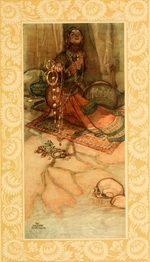


William Blake

The Little Boy Found

Read Next
Literary Commentary
William Blake's 'The Little Boy Found' is an eight-line lyric from Songs of Innocence (1789) that finishes the rescue its companion poem leaves hanging. The lost child of 'The Little Boy Lost' is alone in the fen, led by a wandering light. In these two stanzas a divine figure appears, takes him by the hand, and returns him to the mother who has been searching the dale for him. Eight lines is enough for Blake to stage a complete arc of loss and recovery.
Read by itself, the poem hinges on a simile most readers move past too quickly. God 'appeared like his father, in white.' Like his father, not as the father, not in his place, but in his shape. The earthly father from the previous poem never returns to the scene. What arrives is something that takes the form of paternal care without becoming the father himself. The salvation that follows is bodily: God kisses the child, takes the hand, leads him home. The verbs are tactile, and the comfort is the comfort of being touched.
Read against 'The Little Boy Lost,' the verbal echoes are audible. The 'wandering light' here is the same light the lost boy was following, the marsh-vapour that flew away at the close of the earlier poem, returning now as a path through the fen. The 'lonely dale' the mother walks is an answering landscape to the 'lonely fen' where the boy stood. What was loss in one panel is rescue in the other, and the same materials, light and lonely ground and a child crying, are reordered to deliver the recovery the previous poem withholds.
Key themes
- Divine immanence: God present in the form of human tenderness
- The absent earthly father and the divine substitute
- The wandering light reread under providence
- The mother's grief and the family restored
- Loss-and-recovery as paired structure within Songs of Innocence
Notable craft elements
- The simile 'like his father, in white,' a comparison rather than an equation, which keeps a small gap between the divine and the human
- Verbal echoes binding the two poems: 'wandering light,' 'lonely fen' answered by 'lonely dale,' the child weeping in both panels
- Bodily verbs at the rescue (kissed, led) that give divine care a tactile texture rather than an abstract one
- Internal rhymes 'cry / nigh' (line 3) and 'pale / dale' (line 7), folding the child's distress and the mother's grief into the lines that report them
Reread prompt
Does the simile 'like his father, in white' close the gap between the divine and the absent earthly father, or does the comparison itself preserve a distance the poem refuses to abolish?
See something wrong on this page? Let us know.