










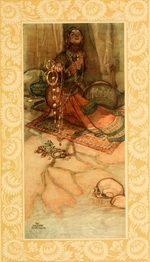


Gavril Derzhavin

To Rulers and Judges
Read Next
Literary Commentary
Gavril Derzhavin composed 'To Rulers and Judges' in 1780 as a free paraphrase of Psalm 82 (numbered 81 in the Slavonic Bible Derzhavin used). Suppressed twice during his lifetime and printed in its final form only in 1808, the ode is the founding Russian poem of moral protest against earthly power, written by a man who served Catherine II, Paul I, and Alexander I as a state official.
The seven quatrains carry a doubled voice. The Old-Testament prophet who opens the poem accuses kings of failing the widow, the orphan and the poor; the eighteenth-century Russian poet who closes it asks God to descend and rule directly. Catherine's court read the ode as politically incendiary, and Derzhavin defended himself with a memorandum, his 'Anekdot,' arguing that King David, the supposed psalm-maker, was hardly a Jacobin.
Yevgeny Bonver's English translation preserves the seven quatrains and the alternating-rhyme principle of Derzhavin's iambic tetrameter, though English line lengths shift and many rhymes go slant. The arc remains intact: God rises in the first stanza to judge 'the earthly ones,' indicts them in the next three, dismantles their pretensions in the fifth and sixth, and is summoned back, in the last, as the only legitimate king.
Key themes
- Divine judgment of earthly rulers
- The ruler's duty to the poor, the widow and the orphan
- Bribery and the corruption of justice
- The mortality of kings
- Prophetic voice as a source of moral authority
Notable craft elements
- Seven quatrains in alternating rhyme; iambic tetrameter in the Russian original
- Apostrophe as the dominant rhetorical mode — first to kings, finally to God
- Slavonicisms and biblical idiom ('hark,' 'havens' dome') that give the Russian its liturgical register
- A first-person pivot at stanza five that places the speaker beside the kings under the same death
Reread prompt
Track the addressee across the seven stanzas — when does the poem speak to kings, when does it speak about them, and when does it turn to God?
See something wrong on this page? Let us know.