







Oscar Wilde

The Harlot's House

Read Next
Literary Commentary
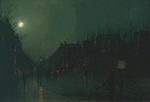
Oscar Wilde published "The Harlot's House" in The Dramatic Review on 11 April 1885, and it became one of the few poems on which his reputation as a poet genuinely rests. The poem stages a nocturnal encounter: a couple pauses outside a brothel, watches the silhouettes of dancers through the window blinds, and the speaker's companion crosses the threshold while dawn creeps into the empty street. In thirty-six lines of triplet stanzas, Wilde fuses the medieval danse macabre with the aesthetics of French Decadence. The result is a poem whose speaker cannot decide whether to condemn the spectacle or keep watching.
The dancers inside are never granted human status. Wilde calls them "strange mechanical grotesques," "wire-pulled automatons," "slim silhouetted skeletons," and "a horrible marionette" that steps outside to smoke a cigarette "like a live thing." The simile is precise in its horror: the puppet resembles a living creature, but the living creature never resembles the puppet. Their laughter is "thin and shrill," their dances a slow quadrille and a stately saraband performed to Strauss's "Treues Liebes Herz" ("True Loving Heart"), a waltz whose sentimental title mocks the loveless machinery below. The sustained automaton metaphor accomplishes something more than Victorian disgust at vice. It registers something of the era's unease about whether desire is freely chosen or mechanically compelled, the fear that the body in pursuit of pleasure becomes indistinguishable from a thing.
The poem turns at stanza ten, when the companion hears the violin and enters. "Love passed into the house of lust," Wilde writes, and the line's flatness is part of its effect: no protest, no struggle, just a statement of transfer. Whether this represents corruption or a more complicated merging of feeling with physical reality remains the poem's central ambiguity. What follows is collapse. The tune goes false, the dancers tire, the shadows stop. Then dawn arrives, personified as a frightened girl with silver-sandalled feet, creeping down the silent street. This final image has divided readers. Some see dawn as moral judgment, light exposing what darkness concealed. Others read it as the girl who replaces the companion, another vulnerable figure approaching danger. Wilde, characteristically, leaves the question open.
Key themes
- Desire and the failure of moral distance
- Mechanization and the dehumanization of bodies
- The collapse of love into lust
- The danse macabre tradition: death-in-life
- Voyeurism and the observer's complicity
Notable craft elements
- Triplet stanzas with couplet-plus-tail rhyme (aab ccb) create a sense of sealed, repeating enclosure that mirrors the mechanical dance
- A sustained automaton metaphor (grotesques, marionettes, skeletons, clockwork puppets) controls the poem's visual vocabulary from stanza three through stanza eight
- The pivotal break at stanza ten, where the companion's departure shatters the observer frame and shifts the poem from description to consequence
- Dawn personified as a frightened girl provides a closing counterimage that refuses to resolve the poem's moral tension
Reread prompt
On a second reading, consider how the speaker's language betrays him: does his elaborate disgust at the dancers conceal a fascination that mirrors his companion's eventual surrender?
See something wrong on this page? Let us know.