









Edgar Allan Poe

To Helen
Read Next
Literary Commentary
Edgar Allan Poe wrote two poems called "To Helen." The first, composed around 1831, is a compact classical tribute. This second version, written in 1848 and addressed to the Providence poet Sarah Helen Whitman, works on an entirely different scale. It is a blank-verse memory poem that recreates a single July midnight three years earlier, when Poe glimpsed Whitman near her rose garden and found himself unable to forget what he saw. Where the earlier "To Helen" (1831) distills admiration into three stanzas of formal poise, this poem stretches a moment of seeing into sixty-five lines of sustained attention that hardens into fixation.
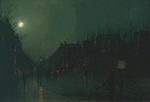
The poem's governing movement is a narrowing of attention. The opening stanza fills the garden with moonlight, roses, and still air, then lets everything dissolve. The roses give out their "odorous souls in an ecstatic death." The moonlight fails. The banks, paths, and trees vanish. What remains is not the woman herself but a single feature: "the divine light in thine eyes." Poe stages the collapse of an entire landscape so that one element can survive it, and the effect is less romantic tribute than a record of how fixation takes hold.
That fixation deepens into something stranger in the final stanza. The beloved's eyes become the speaker's "ministers," yet he is their "slave." They purify him in "electric fire" and "elysian fire," and they fill his soul with "Beauty (which is Hope)." The language borrows from worship, but the structure is closer to bondage. The speaker does not approach Helen or speak to her. He kneels to her eyes as to stars, "in the sad, silent watches of my night." Rescue and captivity share the same gesture.
Poe closes by insisting the eyes persist even "in the meridian glare of day," visible as "two sweetly scintillant / Venuses, unextinguished by the sun." The enchanted garden is long gone, but the vision it produced has become the organizing fact of the speaker's life. This is not a poem that celebrates love returned. It is a poem about what happens when a single act of seeing refuses to end.
Key themes
- Memory as lifelong possession
- Beauty as hope and domination
- Enchantment and the collapse of the surrounding world
- The gaze as spiritual discipline
Notable craft elements
- Blank verse sustained across sixty-five lines, Poe's most accomplished work in unrhymed iambic pentameter.
- Radical narrowing of focus: the poem moves from a full landscape through incremental erasure until only the beloved's eyes remain.
- Repetition as incantation: "Fell on the upturn'd faces of these roses" recurs three times in the first stanza, building a hypnotic, ceremonial rhythm.
- Parenthetical eruptions puncture the meditative surface with bursts of raw feeling: "(Oh, Heaven!- oh, God! / How my heart beats in coupling those two words!)" and "(Ah, bear in mind this garden was enchanted!)"
Reread prompt
Do the beloved's eyes function as a source of rescue, a source of control, or both at once? Track the shift from stanza to stanza and notice where salvation language and bondage language become indistinguishable.
See something wrong on this page? Let us know.