






← Back to “Exposure” by Wilfred Owen

“Exposure” by Wilfred Owen — Literary Analysis
Overview
Wilfred Owen wrote "Exposure" from direct experience of the Western Front in the winter of 1917, and the poem makes a blunt claim: the weather killed soldiers more surely than German bullets. Eight stanzas of five lines each cycle through freezing nights and grey dawns while the refrain "But nothing happens" tolls beneath them. It is a poem about waiting, about cold so severe it becomes the war itself.
The voice is collective throughout. Owen writes as "we," binding himself to the men crouched in their trenches, watching snowflakes drift with what he calls "fingering stealth." There is no heroic charge, no decisive moment. Instead the stanzas move through numbness toward hallucination: the soldiers imagine home fires and warm rooms, only to find the doors shut against them. What begins as physical numbness deepens into something worse: the soldiers become their own ghosts, haunting homes they can no longer enter, until the poem arrives at a bleak theological conclusion. The men accept their deaths because they can no longer believe that warmth or God's love operates anywhere in the world they inhabit.
Owen began the poem at Scarborough in December 1917, revised it through early 1918, and completed the final version in France in September 1918, less than two months before he was killed. The opening line echoes Keats's "Ode to a Nightingale," replacing the heart's ache with the brain's, romanticist longing with a soldier's frozen nerve-pain. The pararhymes that run through every stanza (knive us / nervous, wire / war, snow / renew) leave each couplet slightly off-key, as though the poem itself cannot quite resolve. That formal unease carries the argument as much as any single image: in this war, nothing fits and nothing concludes.
Key Themes
- Nature as the deadliest antagonist, displacing enemy combatants
- Futility and the corrosive monotony of trench warfare
- Alienation from home and the impossibility of return
- Erosion of religious faith under sustained suffering
Notable Craft Elements
- Pararhyme (half-rhyme) throughout, creating a persistent sense of wrongness and irresolution
- Truncated fifth lines that function as refrains, halting each stanza with blunt finality
- Sustained personification of weather as a sentient, hostile force
- First-person plural voice binding the poet to his fellow soldiers in collective suffering
Reread Prompt
On a second reading, trace the progression of the final line in each stanza. Four end with "But nothing happens," while the others pose questions or name dying. What pattern emerges, and how does the last stanza collapse the distance between the two?
Historical Context
Owen experienced the conditions described in "Exposure" during the winter of early 1917, while serving on the Western Front. The cold that winter was severe enough to become a defining memory of his service. Owen was evacuated with shell shock in May 1917 and spent months at Craiglockhart War Hospital near Edinburgh, where he met Siegfried Sassoon. The encounter transformed his poetry. He began "Exposure" at Scarborough in December 1917, after his discharge from Craiglockhart, drawing on those winter memories with the sharper craft Sassoon had helped him develop.
The poem was revised through early 1918 and reached its final form in September of that year, while Owen was back in France. He was killed near Ors, France, on 4 November 1918, one week before the Armistice. "Exposure" was first published in 1920 in the collection Poems by Wilfred Owen, edited by Sassoon with assistance from Edith Sitwell and published by Chatto and Windus. It appeared alongside other poems that would define the canon of First World War literature.
Formal Analysis
The poem consists of eight quintains, each built on a hexameter base that Owen deliberately disrupts. The first four lines of each stanza run long, their six-stress rhythm dragging like the hours the soldiers endure. The fifth line then contracts sharply, often to a half-line, and is set apart by indentation. This truncation gives each stanza the feel of a sentence that collapses before completion. Four of these final lines repeat the refrain "But nothing happens"; the others ask questions or state facts about dying. The effect is cumulative: every stanza reaches toward some resolution and is cut short.
Owen's rhyme scheme follows an approximate ABBA pattern, but the rhymes are almost never exact. Instead he uses pararhyme, matching the consonant frames of words while shifting the vowels: knive us / nervous, brambles / rumbles, grow / grey, renew / nonchalance. Owen developed the technique across several poems, most notably "Strange Meeting," and in "Exposure" it becomes structural rather than incidental. Every stanza sounds as though it should resolve into full rhyme and never does. The ear keeps waiting for a completion that the poem withholds, which is precisely the experience the soldiers undergo: trapped in a situation that neither develops nor ends.
Thematic Analysis
The poem's central argument appears in stanza four, where Owen states that bullets are "less deadly than the air that shudders black with snow." The real enemy is not the opposing army but the weather itself. Dawn becomes a military commander massing her "melancholy army" of clouds; snowflakes approach with "fingering stealth"; the east wind knives. Owen systematically transfers the vocabulary and agency of combat to natural forces, leaving the human war as a distant "dull rumour."
Stanzas five and six stage a hallucination. The freezing soldiers drowse into visions of English countryside, grassier ditches, blackbirds, blossoms. Then their ghosts "drag home" to find shuttered houses, dying fires, mice inheriting the rooms. The doors are closed. This is not nostalgia but its negation: home exists, but the soldiers are already too dead to enter it. The image of the fire as "crusted dark-red jewels" recalls and bitterly subverts the wartime song "Keep the Home Fires Burning."
Stanza seven pushes the alienation to a theological limit. The soldiers accept their fate because they can no longer believe that "kind fires burn" or that "suns smile true on child, or field, or fruit." God's spring is "invincible" but incomprehensible; divine love has withdrawn from the world they know. The closing phrase, "For love of God seems dying," carries a deliberate ambiguity: love directed toward God, love originating from God, and the love that is God may all be perishing at once.
Language & Imagery
The opening line, "Our brains ache, in the merciless iced east winds that knive us," echoes the first line of Keats's "Ode to a Nightingale" ("My heart aches"). Where Keats's ache arises from an excess of beauty, Owen's is physical, neurological, caused by cold. The substitution is pointed: romanticism's interiority has been replaced by the body's blunt protest against the environment. Owen admired Keats throughout his life, and the allusion frames "Exposure" as a kind of anti-ode, a poem in which sensation leads not to transcendence but to paralysis.
Personification dominates the poem's middle stanzas. Dawn is gendered female and given military rank, snowflakes are granted volition and stealth, and the wind goes "mad" in a single adjective that does more work than a stanza of description. These personifications serve a double function. They elevate weather to the status of a conscious enemy, and they simultaneously drain human agency from the scene. The soldiers do not act; they watch, cringe, drowse, stare. Their verbs are passive or reflexive. Against the active weather, the men register only as its objects. Owen reinforces this passivity through progressive verb forms ("watching," "shivering," "dying") that mark states rather than actions, duration rather than events.
Intertextual Connections
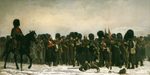
Beyond the Keats allusion, Owen's treatment of exposure connects to a broader tradition of war poetry in which environment threatens soldiers as gravely as the enemy. The classical precedent appears in accounts of Hannibal's crossing of the Alps or Napoleon's retreat from Moscow, where cold becomes a narrative antagonist. Owen, however, strips out any epic frame. There is no march, no grand campaign, only men in holes. His pararhyme technique, developed in conversation with Sassoon and refined across poems like "Strange Meeting" and "Futility," became a hallmark of his late work and is often credited with anticipating the half-rhyme experiments of later poets, including those of the 1930s generation.
Critical Reception
W.B. Yeats excluded Owen from The Oxford Book of Modern Verse in 1936, invoking Matthew Arnold's principle that "passive suffering is not a theme for poetry." The remark, intended as a dismissal, inadvertently identified the poem's radical ambition: to find form and language adequate to an experience in which nothing happens, no one acts heroically, and suffering has no redemptive meaning. Later critics reversed Yeats's verdict. Merryn Williams, writing in 1993, called the poem "mature and brilliant" and praised Owen's "daring half-rhymes" as central to its effect. More recent scholarship, including Isabel B. Stanley's 2022 assessment, has examined how Owen replaces the traditional "war music" of Homer, Virgil, and Shakespeare with what Stanley calls the "eerie keening of wind on wire," making dissonance itself the poem's controlling aesthetic.
Discussion Prompts
- Owen writes that bullets are "less deadly than the air." How does the poem support or complicate this claim across its eight stanzas?
- The refrain "But nothing happens" appears four times. What does "nothing" mean in each instance, and does its meaning shift as the poem progresses?
- What role does the vision of home in stanzas five and six play in the poem's argument? Is it a source of comfort, pain, or something else entirely?
- How does Owen's use of pararhyme (near-rhyme with mismatched vowels) contribute to the poem's emotional effect? Compare a few specific pairings.
Frequently Asked Questions
- What is the meaning of "Exposure" by Wilfred Owen?
- "Exposure" describes soldiers waiting in freezing trenches where the weather is more lethal than the enemy. The repeated refrain "But nothing happens" captures the paradox of trench warfare: men die not in heroic action but from cold, inaction, and exposure to the elements. Owen suggests that nature itself has turned hostile, and that the soldiers have been abandoned by God, country, and even the purpose of the war.
- What literary devices are used in "Exposure"?
- Owen uses personification (dawn "massing her melancholy army," snowflakes "feeling for our faces"), pararhyme (knive/nervous, silent/salient, wire/war), and a recurring refrain that varies slightly in each stanza. The ellipses in the opening lines create a sense of time stretching unbearably. The structure of eight five-line stanzas with a short, indented final line in each mirrors the pattern of waiting punctuated by anticlimax.
- When was "Exposure" written?
- Owen began drafting the poem at Scarborough in December 1917, drawing on his experiences in the flooded dugouts of the Somme sector in January 1917. He continued revising it through 1918, with the final version likely completed in September 1918 during his return to France. The poem was published posthumously in the 1920 edition edited by Sassoon.
- What is the effect of the refrain in "Exposure"?
- The refrain "But nothing happens" closes five of the eight stanzas and varies in the remaining three ("What are we doing here?", "Is it that we are dying?", "We turn back to our dying"). The repetition conveys the monotony and psychological weight of waiting under constant threat. Each variation sharpens the poem's despair, moving from bewilderment to the recognition that inaction is itself a form of dying.
- What is the significance of "His frost" in "Exposure"?
- The capital H in "His frost" identifies the cold as God's instrument, not mere weather. The stanza argues that soldiers lie exposed because they believe kindness and warmth belong to another world. God's spring is "invincible" yet inspires fear, not hope. The theological implication is bleak: the soldiers were "born" for this suffering, and "love of God seems dying." Owen frames the war's cruelty as a crisis of faith, not just a failure of generals.
Sources
- Wilfred Owen. Encyclopaedia Britannica.
- Merryn Williams. Exposure - Poetry Critique. The Wilfred Owen Association, 1993.
- Isabel B. Stanley. Exposure by Wilfred Owen. EBSCO Research Starters, 2022.
- Wilfred Owen: The Poetry is in the Pity. The British Library.
See something wrong on this page? Let us know.