










Henry Wadsworth Longfellow

Snow-Flakes
Read Next
Literary Commentary
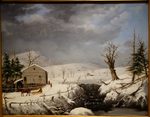
Henry Wadsworth Longfellow's Snow-Flakes is a three-stanza atmospheric lyric in which a snowfall becomes a confession the sky has been holding for a long time. Three sextets, each closing with a contracted couplet, move from pure description to explicit analogy to outright identification: the snow is no longer like grief, it is grief, articulated at last in silent syllables across the bare countryside.
The poem works as a small machine for converting weather into psychology. Stanza one offers nothing but the natural fact — air, cloud-folds, woodlands brown and bare, harvest-fields forsaken — and ends with the descent itself, the meter contracting to two short lines as the snow settles. Stanza two then hinges the analogy with twin clauses: "Even as our cloudy fancies take / Suddenly shape in some divine expression, / Even as the troubled heart doth make / In the white countenance confession." The grammar names what the imagery is doing.
The closing tercet completes the move. "This is the poem of the air, / Slowly in silent syllables recorded; / This is the secret of despair, / Long in its cloudy bosom hoarded." The snow does not stand for despair; the sky has been hoarding despair, and the snow is its release. The audience for this confession is not a listener but a landscape — "whispered and revealed / To wood and field." The reader stands outside, having overheard.
Key themes
- Hidden grief made articulate by nature
- Pathetic fallacy raised to structural method
- Snowfall as written and spoken text
- The slow relief of long-held sorrow finally released
Notable craft elements
- Three matched six-line stanzas rhyming ABABCC, each stanza taking fresh end-sounds
- Each stanza shortens at lines five and six — the longer four-beat lines settle into a brief two-line cadence so the snow descends inside the meter
- Anaphora built into the structure — twin Even as clauses in stanza two, twin This is clauses in stanza three — staging the turn from analogy to identity
- Sustained sibilance and soft consonants, from Silent, and soft, and slow through silent syllables — the hush is engineered
Reread prompt
On a second reading, watch how the poem moves from describing a snowfall, to comparing it to a troubled heart, to declaring it the heart's confession outright. At what line does the analogy stop being analogy and start being identification?
See something wrong on this page? Let us know.