






Henry Wadsworth Longfellow

Haunted Houses
Read Next
Literary Commentary
Henry Wadsworth Longfellow's "Haunted Houses," published in 1858 as part of Birds of Passage (Flight the First), quietly dismantles the Gothic association of its title. The poem's ghosts are not vengeful or terrifying. They are "harmless phantoms" gliding through rooms, "silent as the pictures on the wall." What Longfellow offers is not a ghost story but a philosophical argument: every dwelling accumulates the invisible residue of those who have lived and died within it, and that residue exerts a real, if intangible, force on the living.
The poem divides cleanly at its midpoint. In the first five stanzas, Longfellow builds a domestic inventory of spectral persistence. Ghosts crowd the doorways and sit at tables; the dead reach from their graves to hold property "in mortmain" (a legal term meaning "dead hand," denoting perpetual ownership by an undying entity). The word is precise and unexpected in a poem about phantoms, fusing property law with metaphysics. By stanza five, Longfellow has established that the living merely borrow their houses from the dead. The second half pivots outward. The spirit world, he argues, surrounds the material world "like an atmosphere," and human life is governed by opposing forces: the instinct that enjoys earthly things and the nobler instinct that aspires beyond them.
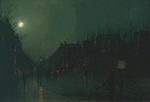
The poem's final two stanzas deliver its most striking image. Moonlight thrown across the sea becomes a "floating bridge of light," and Longfellow compares this to the bridge connecting the spirit world with the physical one. Our thoughts wander that bridge "above the dark abyss." The word choice matters: not a safe crossing but an unsteady floor "that sways and bends." The poem that opened with such domestic calm closes with something vertiginous. Longfellow has moved from drawing rooms to the edge of a cosmic precipice, and his readers find themselves there too.
Key themes
- Memory and the persistence of the dead among the living
- The spirit world as a parallel reality surrounding material existence
- The tension between earthly desire and spiritual aspiration
- Mortality and the impermanence of human ownership
Notable craft elements
- The legal metaphor of "mortmain" (dead hand) fuses property law with the supernatural, grounding the poem's spiritual claims in concrete language
- A sustained simile in stanzas 9-10 compares moonlight on the sea to the bridge between the spirit world and the living, shifting the poem from domestic to cosmic scale
- Steady iambic pentameter and ABAB rhyme create a calm, measured rhythm that resists the Gothic dread the title might promise
Reread prompt
On a second reading, notice where the poem shifts from describing what happens inside a house to making claims about the entire universe. What triggers that expansion, and does the poem earn it?
See something wrong on this page? Let us know.