
Poetry Lovers' Page

About Rudyard Kipling

Kipling gained renown throughout the world as a poet and storyteller. He was also known as a leading supporter of the British Empire. As apparent from his stories and poems, Kipling interested himself in the romance and adventure which he found in Great Britain's colonial expansion.

Read full biography →

British & American Poets

Poetry Lovers' Page

Recent Illustrations

Seasonal Spotlight

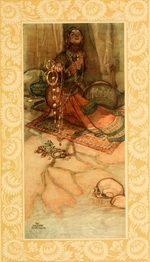
Seated jewel-adorned queen in embroidered robes counting necklaces before a human skull at her feet, in a sumptuous gilded interior. Memorial Day Poems 14 poems

Most Illustrated Poems

Kipling Poem Collections

More by Rudyard Kipling

  1. If
  2. Gunga Din
  3. Mandalay
  4. Boots
  5. Danny Deever
  6. Recessional
  7. Tommy
  8. Lenvoi

Browse by Theme

Explore

You May Also Enjoy

Random Poem

You are here: Home » British/American Poets » Rudyard Kipling » Parade-Song of the Camp-Animals


Rudyard Kipling

Rudyard Kipling

Parade-Song of the Camp-Animals

This poem appears within The Jungle Book (1894).

"Her Majesty's Servants"--The Jungle Book
Elephants of the Gun-Teams
We lent to Alexander the strength of Hercules,
The wisdom of our foreheads, the cunning of our knees.
We bowed our necks to service--they ne'er were loosed again,--
Make way there, way for the ten-foot teams
Of the Forty-Pounder train!
Gun-Bullocks
Those heroes in their harnesses avoid a cannon-ball,
And what they know of powder upsets them one and all;
Then we come into action and tug the guns again,--
Make way there, way for the twenty yoke
Of the Forty-Pounder train!
Cavalry Horses
By the brand on my withers, the finest of tunes
Is played by the Lancers, Hussars, and Dragoons,
And it's sweeter than "Stables" or "Water" to me,
The Cavalry Canter of "Bonnie Dundee!"
Then feed us and break us and handle and groom,
And give us good riders and plenty of room,
And launch us in column of squadron and see
The Way of the War-horse to "Bonnie Dundee!"
Screw-Gun Mules
As me and my companions were scrambling up a hill,
The path was lost in rolling stones, but we went forward still;
For we can wriggle and climb, my lads, an turn up everywhere
And it's our delight on a mountain height, with a leg or two to spare!
Good luck to every sergeant, then, that lets us pick our road:
Bad luck to all the driver-men that cannot pack a load!
For we can wriggle and climb, my lads, and turn up everywhere,
And it's our delight on a mountain height, with a leg or two to spare!
Commissariat Camels
We haven't a camelty tune of our own
To help us trollop along,
But every neck is a hair-trombone
(Rtt-ta-ta-ta! is a hair-trombone! )
And this is our marching-song:
Can't! Don't! Shan't! Won't!
Pass it along the line!
Somebody's pack has slid from his back,
'Wish it were only mine!
Somebody's load has tipped off in the road--
Cheer for a halt and a row!
Urrr! Yarrh! Grr! Arrh!
Somebody's catching it now!
All The Beasts Together
Children of the Camp are we,
Serving each in his degree;
Children of the yoke and goad,
Pack and harness, pad and load.
See our line across the plain,
Like a heel-rope bent again,
Reaching, writhing, rolling far,
Sweeping all away to war!
While the men that walk beside,
Dusty, silent, heavy-eyed,
Cannot tell why we or they
March and suffer day by day.
Children. of the Camp are we,
Serving each in his degree;
Children of the yoke and goad,
Pack and harness, pad and load!

This Poem Appears In

More by Rudyard Kipling

  1. If
  2. Gunga Din
  3. Mandalay
  4. Boots
  5. Danny Deever

Literary Commentary

Rudyard Kipling's "Parade-Song of the Camp-Animals" closes The Jungle Book (1894) as a verse companion to the story "Her Majesty's Servants," in which camp animals debate their roles in the British Indian Army. The poem assigns each animal type its own marching song, set to a different traditional military tune, creating a medley of six distinct voices: elephants, gun-bullocks, cavalry horses, screw-gun mules, commissariat camels, and a choral finale in which all beasts sing together. The result is both a comic songbook and a compressed portrait of army life as seen from below the saddle.

Each section captures a different temperament through rhythm and diction. The elephants open with stately allusions to Alexander and Hercules, claiming ancient lineage in the meter of "The British Grenadiers." The bullocks follow with blunt pragmatism, noting that the elephants bolt when the guns actually fire. Cavalry horses canter through lines borrowed from Walter Scott's "Bonnie Dundee," while the screw-gun mules swagger to "The Lincolnshire Poacher," boasting of their agility on mountain trails. The commissariat camels get the poem's most inventive passage: a cacophony of complaints and onomatopoeia that collapses into sputtering nonsense sounds. The camels have no proper tune and know it, which is the joke.

The final section gathers every voice into a single marching meter. Here the tone shifts. The animals name themselves "Children of the yoke and goad" and describe their column sweeping across the plain toward war. The closing lines admit that neither the beasts nor the men walking beside them, "dusty, silent, heavy-eyed," can explain why they march and suffer. Beneath the comic parade, Kipling plants an honest question about the cost of obedience that his story, with its celebration of hierarchy, does not fully answer.

Key themes

  • Service and obedience across different military branches
  • Unity emerging from diversity of roles and temperaments
  • Animal voices as portraits of military character and ethos
  • The unspoken cost of service beneath comic spectacle

Notable craft elements

  • Each animal section set to a different traditional British military tune (The British Grenadiers, Bonnie Dundee, The Lincolnshire Poacher), with meter and rhythm shifting to match
  • Dramatic voice-switching: six distinct speakers differentiated by diction, attitude, and verse form within a single poem
  • Onomatopoeia and comic sound-play in the camels' section, breaking into pure noise as a comic counterpoint to the disciplined verses around it

Reread prompt

Why does Kipling end this comic medley not with triumph but with the admission that neither beasts nor men understand why they march and suffer?

See something wrong on this page? Let us know.

x
By using our website, you agree to our cookie policy.