



Poetry Lovers' Page

About Rudyard Kipling

Kipling gained renown throughout the world as a poet and storyteller. He was also known as a leading supporter of the British Empire. As apparent from his stories and poems, Kipling interested himself in the romance and adventure which he found in Great Britain's colonial expansion.

Read full biography →

British & American Poets

Poetry Lovers' Page

Recent Illustrations

Seasonal Spotlight

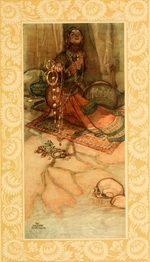
Seated jewel-adorned queen in embroidered robes counting necklaces before a human skull at her feet, in a sumptuous gilded interior. Memorial Day Poems 14 poems

Most Illustrated Poems

Kipling Poem Collections

More by Rudyard Kipling

  1. If
  2. Gunga Din
  3. Mandalay
  4. Boots
  5. Danny Deever
  6. Recessional
  7. Tommy
  8. Lenvoi

Browse by Theme

Explore

You May Also Enjoy

Random Poem

You are here: Home » British/American Poets » Rudyard Kipling » The English Flag


Rudyard Kipling

Rudyard Kipling

The English Flag

Tall wooden sailing ship riding sunlit waves toward shore, with small figures huddled on the beach with bundles beside a second ship silhouetted at the horizon.
The English Flag (Heath Robinson) — by W. Heath Robinson (1910)
Above the portico a flag-staff, bearing the Union Jack,
remained fluttering in the flames for some time, but ultimately
when it fell the crowds rent the air with shouts,
and seemed to see significance in the incident. -- DAILY PAPERS.
Winds of the World, give answer! They are whimpering to and fro --
And what should they know of England who only England know? --
The poor little street-bred people that vapour and fume and brag,
They are lifting their heads in the stillness to yelp at the English Flag!
Must we borrow a clout from the Boer -- to plaster anew with dirt?
An Irish liar's bandage, or an English coward's shirt?
We may not speak of England; her Flag's to sell or share.
What is the Flag of England? Winds of the World, declare!
The North Wind blew: -- "From Bergen my steel-shod vanguards go;
I chase your lazy whalers home from the Disko floe;
By the great North Lights above me I work the will of God,
And the liner splits on the ice-field or the Dogger fills with cod.
"I barred my gates with iron, I shuttered my doors with flame,
Because to force my ramparts your nutshell navies came;
I took the sun from their presence, I cut them down with my blast,
And they died, but the Flag of England blew free ere the spirit passed.
"The lean white bear hath seen it in the long, long Arctic night,
The musk-ox knows the standard that flouts the Northern Light:
What is the Flag of England? Ye have but my bergs to dare,
Ye have but my drifts to conquer. Go forth, for it is there!"
The South Wind sighed: -- "From the Virgins my mid-sea course was ta'en
Over a thousand islands lost in an idle main,
Where the sea-egg flames on the coral and the long-backed breakers croon
Their endless ocean legends to the lazy, locked lagoon.
"Strayed amid lonely islets, mazed amid outer keys,
I waked the palms to laughter -- I tossed the scud in the breeze --
Never was isle so little, never was sea so lone,
But over the scud and the palm-trees an English flag was flown.
"I have wrenched it free from the halliard to hang for a wisp on the Horn;
I have chased it north to the Lizard -- ribboned and rolled and torn;
I have spread its fold o'er the dying, adrift in a hopeless sea;
I have hurled it swift on the slaver, and seen the slave set free.
"My basking sunfish know it, and wheeling albatross,
Where the lone wave fills with fire beneath the Southern Cross.
What is the Flag of England? Ye have but my reefs to dare,
Ye have but my seas to furrow. Go forth, for it is there!"
The East Wind roared: -- "From the Kuriles, the Bitter Seas, I come,
And me men call the Home-Wind, for I bring the English home.
Look -- look well to your shipping! By the breath of my mad typhoon
I swept your close-packed Praya and beached your best at Kowloon!
"The reeling junks behind me and the racing seas before,
I raped your richest roadstead -- I plundered Singapore!
I set my hand on the Hoogli; as a hooded snake she rose,
And I flung your stoutest steamers to roost with the startled crows.
"Never the lotus closes, never the wild-fowl wake,
But a soul goes out on the East Wind that died for England's sake --
Man or woman or suckling, mother or bride or maid --
Because on the bones of the English the English Flag is stayed.
"The desert-dust hath dimmed it, the flying wild-ass knows,
The scared white leopard winds it across the taintless snows.
What is the Flag of England? Ye have but my sun to dare,
Ye have but my sands to travel. Go forth, for it is there!"
The West Wind called: -- "In squadrons the thoughtless galleons fly
That bear the wheat and cattle lest street-bred people die.
They make my might their porter, they make my house their path,
Till I loose my neck from their rudder and whelm them all in my wrath.
"I draw the gliding fog-bank as a snake is drawn from the hole,
They bellow one to the other, the frighted ship-bells toll,
For day is a drifting terror till I raise the shroud with my breath,
And they see strange bows above them and the two go locked to death.
"But whether in calm or wrack-wreath, whether by dark or day,
I heave them whole to the conger or rip their plates away,
First of the scattered legions, under a shrieking sky,
Dipping between the rollers, the English Flag goes by.
"The dead dumb fog hath wrapped it -- the frozen dews have kissed --
The naked stars have seen it, a fellow-star in the mist.
What is the Flag of England? Ye have but my breath to dare,
Ye have but my waves to conquer. Go forth, for it is there!"

More by Rudyard Kipling

  1. If
  2. Gunga Din
  3. Mandalay
  4. Boots
  5. Danny Deever

Literary Commentary

Rudyard Kipling published "The English Flag" in April 1891, and the critic Charles Carrington later called it the poet's first national ode. The poem summons the four cardinal winds to answer a single question: what is the flag of England? Each wind responds from its own domain, cataloguing the oceans, ice fields, jungles, and trade routes where the Union Jack has flown. The result is less a hymn to bunting than a challenge to domestic critics whom Kipling dismisses as "street-bred people" ignorant of what sustains their comfort.

Symmetry governs the poem's architecture. North, South, East, and West testify in turn, moving from Arctic whaling grounds to coral atolls, from Asian typhoons to Atlantic fog banks. Every section closes with the same dare: go forth, for the flag is there. But the recurring refrain carries a darker note than simple pride. The East Wind speaks of souls departing on its breath, of English bones holding the flag upright. Kipling's celebration is inseparable from his insistence on cost.

Written when Kipling was twenty-five and newly returned from India, "The English Flag" stands at the threshold of his career as a poet of empire. The long, surging couplets pack more geographic detail per line than almost anything else in Victorian verse, and their rolling rhythm carries the reader forward with genuine momentum. Yet the poem's assumptions about imperial duty drew scrutiny from the start. Lionel Johnson, reviewing it in the Academy in 1891, found the tone "grievously spoiled by exaggeration." That tension between kinetic energy and ideological freight has only sharpened with time.

Key themes

  • Imperial reach and the human cost of maintaining an empire
  • Nature as witness and adversary to human ambition
  • Domestic complacency versus the sacrifices of those who serve abroad
  • National identity defined not by geography but by global commitment

Notable craft elements

  • Four personified winds serve as dramatic speakers, each with a distinct geographic voice and temperament
  • A recurring refrain binds the four sections into a unified rhetorical challenge
  • Fourteener couplets (seven-stress lines rhyming in pairs) sustain narrative momentum across 68 lines

Reread prompt

On a second reading, notice how each wind's personality differs: which sounds most admiring of the English, which most threatening, and what does that difference reveal about Kipling's view of empire?

See something wrong on this page? Let us know.

x
By using our website, you agree to our cookie policy.