





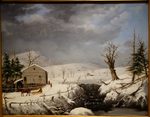

← Back to “Out, Out—” by Robert Frost

“Out, Out—” by Robert Frost — Literary Analysis
Overview
Robert Frost's "Out, Out—" recounts a boy's death by buzz saw in rural New England, drawn from a real 1910 accident in Franconia, New Hampshire. The title borrows from Macbeth's soliloquy on life's brevity, but Frost refuses Shakespeare's rhetorical grandeur. Instead, the poem delivers its violence in the plain language of someone reporting what happened. The collision between pastoral calm and sudden mutilation gives the poem its particular force: five mountain ranges glow under the sunset while a saw meets a boy's hand.
What distinguishes the poem is not the accident but what follows it. The boy dies, and the final two lines record the response of those around him: they turn back to their affairs. Frost does not editorialize. He does not condemn the survivors or mourn the boy in elevated language. The narrator's detachment is the poem's most deliberate and most disturbing choice. Whether that detachment reflects pragmatic rural stoicism or something colder, Frost leaves for the reader to determine.
Written six years after the incident that inspired it, the poem appeared in Mountain Interval (1916) alongside "Birches" and "The Road Not Taken." It belongs to a strain in Frost's work that runs darker than his reputation as a pastoral sage suggests. Paired with "Home Burial," which examines grief tearing apart a marriage after a child's death, "Out, Out—" reveals Frost's persistent, unsentimental attention to the ways death disrupts and fails to disrupt ordinary life.
Key Themes
- Death as abrupt, arbitrary interruption rather than meaningful event
- The gap between childhood and the adult labor imposed on children
- The indifference or pragmatism of the living in the face of death
- Technology as an impersonal, quasi-animate agent of destruction
- The inadequacy of language and response before sudden loss
Notable Craft Elements
- Blank verse (unrhymed iambic pentameter) with spondaic substitutions at moments of crisis, disrupting the poem's conversational rhythm precisely when violence arrives
- Personification of the buzz saw as a sentient predator that 'snarled,' 'rattled,' and 'leaped,' creating ambiguity about whether the machine or the boy bears responsibility
- Compression of the boy's dying into three staccato beats ('Little—less—nothing!'), enacting the collapse of a life in the space of three words
- A single unbroken stanza that refuses to pause, mirroring the relentless momentum from pastoral scene to death to the survivors' resumption of daily business
Reread Prompt
On a second reading, track the narrator's tone from the opening pastoral description through the accident to the final two lines. At what point does the voice shift from storytelling to something harder to name, and what does that shift reveal about the poem's moral stance?
Historical Context
The poem is rooted in a specific tragedy. On March 24, 1910, Raymond Tracy Fitzgerald, a teenager living near Bethlehem, New Hampshire, lost his hand to a buzz saw while cutting wood in his dooryard. He died shortly afterward from shock and heart failure. Frost, then living nearby in Franconia, knew the Fitzgerald family; his children had played with Raymond. The poem did not appear until six years later, first published in the July 1916 issue of McClure's magazine, then collected in Mountain Interval that November.
Mountain Interval was Frost's third volume, following A Boy's Will (1913) and North of Boston (1914). It appeared during the First World War, a period when sudden, meaningless death had become a mass experience rather than a rural accident. Frost never explicitly connects the poem to the war, but the final lines, where the living simply resume their routines, carry an additional weight in a year when millions of families were doing exactly that. The volume also contains "The Road Not Taken" and "Birches," poems that share Frost's characteristic method of embedding philosophical complexity beneath apparently simple rural surfaces.
Formal Analysis
The poem consists of thirty-four lines of blank verse arranged in a single, unbroken stanza. Frost's choice of iambic pentameter gives the poem the cadence of natural speech, appropriate for a narrative that presents itself as a plainspoken account. But the meter is not uniform. At key moments, Frost introduces spondaic feet that force the reader to slow down. The opening line, 'The buzz-saw snarled and rattled in the yard,' front-loads stressed syllables in 'buzz-saw snarled,' disrupting the iambic pulse to mimic the saw's aggressive sound.
The single-stanza form is itself a statement. There are no section breaks, no white space to signal a pause between the peaceful scene and the catastrophe. The poem moves from sunset to severed hand to death to the survivors' return to work without offering the reader a moment to absorb what has happened. This formal compression mirrors the poem's thematic claim: life does not pause for individual deaths. The final lines are notably shorter in their phrasing, the syntax clipping down to fragments. 'Little—less—nothing!—and that ended it' collapses a dying boy into punctuation.
Thematic Analysis
The poem opens with a scene split between beauty and menace. The saw snarls; the breeze carries sweet-scented wood dust; five mountain ranges recede into the Vermont sunset. Frost holds these two registers in suspension for nine lines before acknowledging, almost parenthetically, that 'nothing happened: day was all but done.' The word 'nothing' is loaded. In retrospect, the reader understands that everything is about to happen, and the poem's real subject is the terrible speed of that transition from nothing to everything.
The ending remains the poem's most debated passage. 'No more to build on there. And they, since they / Were not the one dead, turned to their affairs.' Frost's critics have read this variously as a condemnation of callousness, a recognition of rural necessity, and a statement about the human inability to sustain grief. William Pritchard noted that the narrator refuses to provide guidance, either 'tragic or otherwise,' leaving the reader without a moral frame. The ambiguity is essential. Frost does not tell us whether turning to one's affairs is a failure of feeling or a condition of survival. The poem's power depends on that refusal.
Language & Imagery
The saw dominates the poem's imagery. Frost personifies it as something between an animal and a malicious intelligence: it 'snarled and rattled,' it 'leaped out at the boy's hand, or seemed to leap.' That qualifier, 'or seemed to leap,' is crucial. It introduces doubt about agency. Did the saw attack, or did the boy's hand slip? Frost's equivocation, 'He must have given the hand,' refuses to settle the question. The meeting of hand and blade is described with a strange formality: 'Neither refused the meeting.' The diction belongs to a social encounter, not a mutilation, and the mismatch produces a quiet horror.
The boy's response compounds that horror with specificity. His 'first outcry was a rueful laugh,' a detail too odd to be invented and too precise to be generic. He holds up his hand 'Half in appeal, but half as if to keep / The life from spilling,' a simile that turns blood into something almost liquid, capable of being lost through carelessness rather than violence. The compression intensifies as the boy dies: 'Little—less—nothing!' Three words, three dashes, and a life is over. The rhythm enacts the pulse slowing to silence.
Intertextual Connections
The title directs us to Macbeth, Act 5, Scene 5: 'Out, out, brief candle! / Life's but a walking shadow, a poor player / That struts and frets his hour upon the stage / And then is heard no more.' Macbeth speaks these lines upon learning of his wife's death, reducing all human experience to a meaningless performance. Frost's poem enacts this nihilism without stating it. The boy's life is indeed a brief candle, snuffed by an accident that has no villain, no moral, no redemptive arc. But where Macbeth's speech is oratorical, Frost's poem is flat, which makes its bleakness harder to dismiss as rhetoric.
Within Frost's own work, "Out, Out—" pairs most naturally with "Home Burial," another poem about death in rural New England. Where "Home Burial" examines grief at length through the agonized dialogue of husband and wife, "Out, Out—" compresses everything into thirty-four lines and then walks away. The two poems approach the same subject from opposite distances, and together they map Frost's range: from sustained psychological drama to a terseness that borders on refusal. "Nothing Gold Can Stay" and "Fire and Ice" share the theme of destruction, though in condensed lyric form rather than narrative.
Critical Reception
Harold Bloom identified "Out, Out—" as 'one of Frost's most respected poems,' while noting that it has received less sustained critical attention than "The Road Not Taken" or "Stopping by Woods on a Snowy Evening." Among those who have engaged closely with it, William Pritchard praised its grimness and the narrator's refusal to moralize. Jeffrey Meyers called it 'one of his greatest poems,' reading the final lines as an indictment of emotional indifference rather than a neutral observation. Jay Parini valued its 'complex and suggestive ambiguity,' arguing that the poem demands active interpretation rather than passive reception. The critical consensus places it alongside "Home Burial" and "Acquainted with the Night" as evidence that Frost's work runs far darker than his public image as a New England sage ever suggested.
Discussion Prompts
- The narrator says, 'Call it a day, I wish they might have said.' How does this interjection change the poem's tone? Is the narrator assigning blame, or simply registering regret?
- Frost writes that the saw 'Leaped out at the boy's hand, or seemed to leap— / He must have given the hand.' Why does Frost equivocate about who or what caused the accident? What is at stake in the question of agency?
- The final two lines describe the survivors turning 'to their affairs.' Is Frost condemning their response, understanding it, or simply recording it? What evidence in the poem supports your reading?
- Compare the treatment of death in "Out, Out—" with that in "Home Burial." How does the length and form of each poem shape its emotional impact?
- The poem is set in Vermont, but Frost published it during the First World War. Does the wartime context change how you read the poem's treatment of sudden death and the survivors' response?
Frequently Asked Questions
- What is "Out, Out—" by Robert Frost about?
- The poem narrates a boy's death after a buzz saw severs his hand while he cuts wood in a Vermont dooryard. Based on a real 1910 accident near Bethlehem, New Hampshire, the poem moves from a pastoral scene of mountains and sunset to sudden mutilation, the boy's shocked plea to save his hand, and his death under ether. The final two lines record the survivors simply turning back to their work.
- What is the meaning of the title "Out, Out—"?
- The title quotes Macbeth's soliloquy in Act 5, Scene 5: "Out, out, brief candle!" where Macbeth declares life a meaningless performance after learning of his wife's death. Frost borrows the nihilism but strips away the rhetoric. Where Shakespeare gives Macbeth grand oratory, Frost delivers the same conclusion through flat, plainspoken narrative, making the bleakness harder to dismiss as dramatic posturing.
- What literary devices are used in "Out, Out—"?
- Frost personifies the buzz saw as a predator that "snarled and rattled" and "leaped out at the boy's hand." The poem uses blank verse with spondaic disruptions at moments of violence. Its single unbroken stanza refuses to pause between pastoral calm and catastrophe. The compression of dying into "Little—less—nothing!" enacts a pulse stopping in three words and three dashes.
- Is "Out, Out—" based on a true story?
- Yes. On March 24, 1910, Raymond Tracy Fitzgerald, a teenager near Bethlehem, New Hampshire, lost his hand to a buzz saw while cutting wood and died shortly afterward from shock and heart failure. Frost, then living in nearby Franconia, knew the Fitzgerald family. He waited six years before publishing the poem, first in McClure's magazine in July 1916, then in his collection Mountain Interval that November.
- What is the theme of "Out, Out—"?
- The poem treats death as an abrupt, arbitrary interruption rather than a meaningful event. It examines the gap between a child doing adult labor and the adult world's response when that child dies. The survivors' return to daily routine raises an unresolved question: whether their pragmatism reflects rural necessity, emotional limitation, or a universal human inability to sustain grief in the face of life's demands.
- What do the last two lines of "Out, Out—" mean?
- "No more to build on there. And they, since they / Were not the one dead, turned to their affairs." Frost does not tell the reader whether to condemn or understand the survivors. Critics have read the lines as an indictment of callousness, a recognition of rural pragmatism, or a statement about the human inability to sustain grief. The poem's power depends on Frost refusing to settle the question.
- How does "Out, Out—" compare to Frost's "Home Burial"?
- Both poems address death in rural New England but from opposite distances. "Home Burial" stretches grief across 120 lines of agonized dialogue between a husband and wife after their child's death. "Out, Out—" compresses everything into 34 lines and then walks away. Together they map Frost's range: sustained psychological drama on one hand, a terseness that borders on refusal on the other.
Sources
- William Pritchard. Frost: A Literary Life Reconsidered. Oxford University Press, 1984.
- Jeffrey Meyers. Robert Frost: A Biography. Houghton Mifflin, 1996.
- Jay Parini. Robert Frost: A Life. Henry Holt, 1999.
See something wrong on this page? Let us know.